Next retreat: Mandala Dance Level 1 with Maya · 9–15 November 2026 · Austria→
Level 1 retreat in Austria · 9–15 November

Mandala Dance

A practice by Maya Mandala for working with energy, body and consciousness. It combines dance movements, breathing and attention skills in one system.

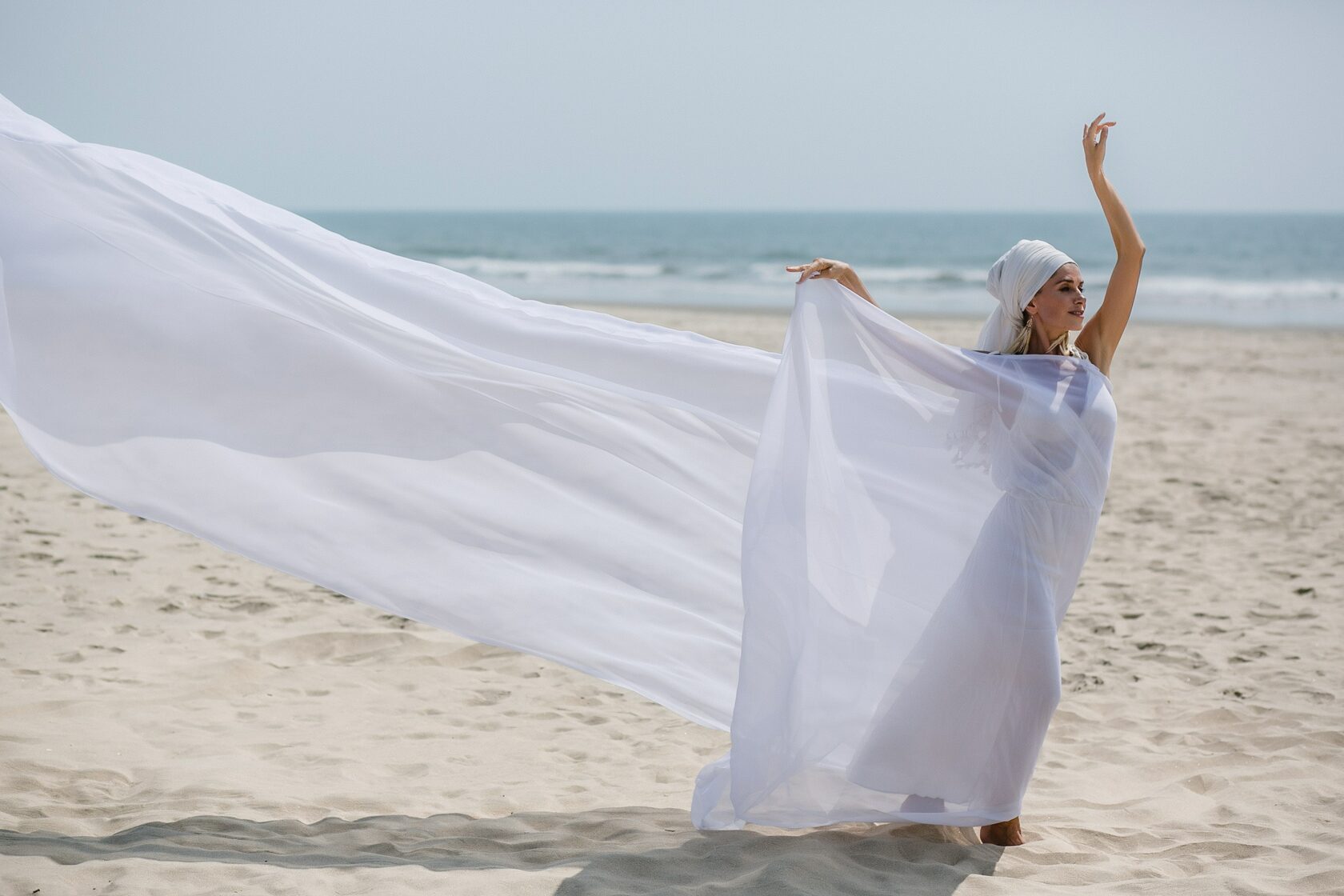
Maya Mandala dancing in a white headscarf with a long flowing veil on the seashore, full length
Maya Mandalaauthor of the practice
What it is

Mandala Dance

Mandala Dance by Maya: a dance film from Maya Mandala’s YouTube channel.

Mandala Dance is an authorial practice created by Maya Mandala. It is built from smooth spiral, wave and circular movements and figure-eights, coordinated with conscious breathing and attention. The forms follow sacred geometry: the circle, the spiral, the figure-eight and the wave.

The word mandala means circle — the oldest image of wholeness, one that unites all states of a person. In the practice this image becomes movement: the dancer walks the inner circle with the body, and the dance gathers scattered parts of the self into one whole.

Maya describes the practice as a sacred system: the mandala of the body and the mandala of the elements of the planet, close in structure to the Flower of Life. Movement through the figure-eight, the circle and the spiral follows the basic principle of how energy moves.

  • Authorial method created by Maya Mandala, who has taught it for 17+ years
  • Movements built on sacred geometry: circle, spiral, figure-eight, wave
  • Breathing and attention work woven into each movement
  • One of the practices of the school alongside Dakini Dance, Wave Yoga and Egyptian Yoga
  • Open to beginners and experienced movers alike

“Because mandala is an image of wholeness.”

Maya Mandala, Mandala Dance seminar

Read the full explanation: what Mandala Dance is

Author and method

Created by Maya Mandala

Mandala Dance is an authorial method with a documented form. Maya Mandala created it and has been teaching it for more than seventeen years. Certified facilitators pass the practice on, two books describe it, and video materials preserve the movements and principles.

Name
Mandala Dance (in Russian: Танец Мандала)
Author
Maya Mandala
Roots
Maya’s root teaching is Dzogchen; the Sufi tradition of dance, poetry and song also shaped her path
Teaching
17+ years of teaching Mandala Dance in Europe, Asia and Russia
Structure
Spiral, wave and circular movements, figure-eights; coordinated with breathing and attention
Geometry
The circle, the spiral, the figure-eight and the wave; the Flower of Life as the basis of the mandala pattern
Documented in
Books “Mandala Dance” (2017) and “Mandala Dance. 2nd level”; a collection of video practices
Rights
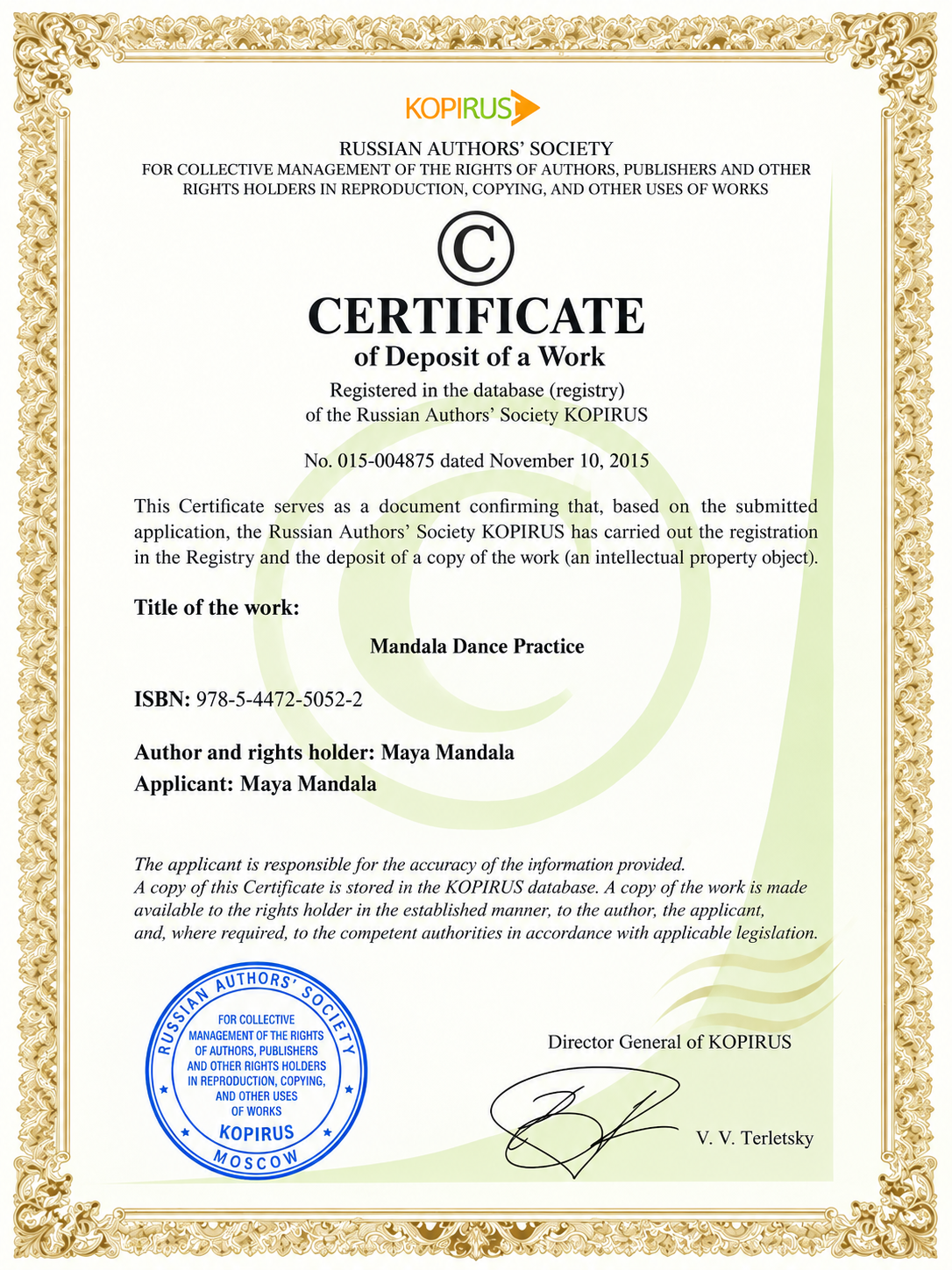
The work “Mandala Dance Practice” by Maya Mandala is deposited with the Russian Authors’ Society KOPIRUS: certificate of deposit No. 015-004875, issued 10 November 2015 (see the certificate)
Carried by
Certified facilitators in 60+ cities across 12 countries
How it was created

The story behind the practice

Mandala Dance grew out of a long search through traditions, framed by two root lineages: Buddhist practice and the Sufi tradition with its dance, poetry and song. The account below follows what Maya herself tells in an interview published in 2019.

  1. Years on the path

    In that interview Maya speaks of fifteen years on the spiritual journey and of meeting the masters with whom her soul has a strong connection. Her main lineage comes from Buddhism — Dzogchen is her root teaching — and she also studied in the Sufi tradition, where dance, poetry and song lead back to the divine.

  2. Many ways of dancing

    Because she loves dance, she explored modern and contemporary dance, contact improvisation, African dance, a little belly dance, tango and flamenco. Sufism gave her ecstatic experience, but its dance has one shape — the whirling. She wanted the praying quality of that dance together with many forms of expression.

  3. The female lineage

    In tantra workshops Maya saw how different women and men are: different natures, different ways to heal and to feel the body. She began to search for the female lineage — a temple dance, a way to move so that the body feels sacred, like a temple. In the dances she knew, she could not find it at that time.

  4. The inner voice

    She turned to meditation and asked how to find the wisdom for women and how a woman’s body works from inside. Maya says: “my intuition, my inner voice, said: you need to dance, you need to search through the dance.”

  5. About a year of practice

    Every morning she listened to the energy and the body and danced, giving attention to how the energy moves her instead of controlling it. The memory of the temple dance began to open — not all at once, but over about a year of practice — together with the way to transmit it to women.

  6. The first women

    When she first gave the practice to women, they had a strong experience: inspiration, healing, a long journey back to their nature. Maya then taught classes five times a week for more than a year, watching how women received and understood it.

  7. Levels and books

    For many people it was too much and too strong at once, so she created further practices and levels and began to teach more slowly. The method is documented in the books “Mandala Dance” (2017) and “Mandala Dance. 2nd level”; today it is passed on by certified facilitators in 60+ cities across 12 countries.

“…how to move inside my body and feel sacred inside, like a temple.”

Maya Mandala, in an interview

Maya tells this story in an interview with Mayuri. Read the full article.
Philosophy

Why the circle

The circle is the oldest image of wholeness a person has. In Mandala Dance the circle becomes a path: the dancer moves through states arranged along it, and attention gathers body, emotions and mind into one gesture.

Maya describes the practice as her way of praying — a temple dance turned inward. Each class keeps this quiet inner orientation, whatever the background of the person dancing.

“It’s like temple dance — your way to pray, to the divine within yourself and outside, and to feel this, feel this taste, feel this life, feel all of nature.”

Maya Mandala, in an interview
The method

Six principles of the practice

01

Presence

Conscious experiencing of presence in the body. The practice begins with attention turning to what is happening right now.

02

Breath

Breathing leads every movement. The breath sets the pace, and the movement follows its rhythm.

03

Form

The geometry of the mandala: circle, spiral, figure-eight, wave. Clear forms hold attention and free it from everyday noise.

04

Attention

Attention stays inside the movement. The dancer watches states appear and dissolve, staying in the role of witness.

05

Emotion

Emotions move through the body and complete themselves in the dance — with care and without pressure.

06

Wholeness

The parts of the self come together: body, feelings, thoughts and will act as one whole.

“That’s the principle of the Mandala: to bring in all the elements, to bring in all the parts of ourselves, into one.”

Maya Mandala, in an interview
Sacred geometry

Four forms that organise the dance

In Maya’s teaching the dance follows the geometry of the mandala. Four forms organise the movement, and each line drawing below shows the path of one of them.

Circle

The circle gathers. The dancer returns to the same point — the closed form of wholeness and of the mandala itself.

Spiral

The spiral opens from the centre. The movement grows outward without losing the centre.

Figure-eight

The figure-eight is one continuous line with two loops that cross at the centre. The body traces it without a break, one loop passing into the other.

Wave

The wave rises and falls. Breathing and movement travel through the body in smooth, unbroken waves.

“In essence, the mandala is like a sacred geometry, a sacred geometry that unites all states, all manifestations of the whole.”

Maya Mandala, Mandala Dance seminar
A class

How a class is built

Facilitators describe a class as a gradual way into the dance: first the body and attention, then the movement, then the dance itself.

1

Warm-up

The body is warmed up well before the dance — facilitators give this part special attention.

2

Presence

Attention comes out of thoughts and into the body. Presence in the body is where the practice begins.

3

Building the dance

The movement is learned element by element. As lightness and presence appear in the body, the dance can go deeper.

4

The dance

Spiral, wave and circular movements and figure-eights, coordinated with breath and attention, form a mandala that is each time unique.

“The first thing that’s important for a dancer is conscious experiencing of presence in the body.”

Maya Mandala, in conversation with Valentina Fratu
Structure

Three levels of the practice

Foundation1

Level 1

An in-person preparatory retreat. Students learn the foundation of the practice, align the body and meet their Individual Mandala. It prepares the dance — it is not yet the full dance.

Circle2

Level 2

The practice turns toward the circle: empathy, listening and moving in one rhythm with others. Here the full transition into the dance begins.

Wholeness3

Level 3

The Manifested Mandala of the Universe: wholeness, consciously passing through the states formed by the sacred pattern of the dance.

Why levels? Maya explains it from experience. When she first gave the practice whole, it was too strong for many people: it brings up everything a person carries, in body, memory and energy. So, she says, “I came to give different levels and to teach more slowly.”

The Level 1 retreat is intended for personal practice. Facilitator certificates are issued later in the path — after confirmation of proficiency at the Level 2 or Level 3 stage. More on the path of facilitators.

Experience

What the practice gives

Practitioners describe regular practice as a way to build a steadier, more alive relationship with the body, attention and emotional life.

  • Deeper contact with the body and its signals
  • Easier, freer movement; plasticity and grace
  • A calmer, steadier state of mind
  • Release of tension held in the body
  • Space to feel and complete emotions with care
  • A gathered mind and clearer attention
  • More confidence and presence in everyday life
  • A sense of contact with your own wholeness

Experiences differ from person to person, and no result is guaranteed. Mandala Dance does not replace medical treatment or psychotherapy.

“…if you’re not in the body, you’re missing your life.”

Maya Mandala, in an interview
For whom

Who the practice is for

  • Those who feel disconnected from their body and want to come back to it
  • Those who carry constant tension and look for a gentle way to release it
  • Women drawn to sacred dance and the image of the mandala
  • Beginners with no dance background who want a clear, well-held method
  • Practitioners of yoga and meditation who want movement to carry their practice deeper
  • Those going through a life transition and looking for a steady inner support

Maya teaches international retreats and seminars for men and women; the Level 1 retreat described on this page takes place in a women’s circle. Write to us if you are unsure whether the retreat fits you.

Comparison

Mandala Dance and yoga

People often ask how Mandala Dance relates to yoga. Both work with the body and breath; the two practices differ in origin, form, purpose and the way they are taught.

Origin

Mandala DanceA modern authorial method created by Maya Mandala.

YogaAn ancient tradition that developed over millennia.

Form

Mandala DanceThe body draws its own geometry: circle, spiral, figure-eight, wave — through hands, hips and the whole body.

YogaCodified postures held and refined on the mat.

Purpose

Mandala DanceEmbodied presence and self-discovery through movement and dance.

YogaA broad path with goals that range from fitness and flexibility to liberation.

Teaching

Mandala DanceTransmitted by Maya and certified facilitators in clear, documented levels.

YogaTaught within many established lineages and styles.

“And the dance is built precisely on sacred geometry, precisely on the sacred quality of consciousness, energy and body.”

Maya Mandala, Mandala Dance seminar

Read the full comparison of Mandala Dance and yoga

How to start

Two ways to begin

Begin at home with a recorded lesson, or join Maya in person at the Level 1 retreat. The recording is for solo practice at home; at the retreat Maya teaches live.

At home · Recorded lesson

Mandala Dance Level 1 with Maya

  • 85 minutes
  • 30 days of access
  • Recorded video

A recorded Level 1 lesson for solo practice at home. In the video, Maya explains the practice on the physical and energetic levels. It is designed for people who already know Mandala Dance and want to deepen their practice, and it also suits newcomers who want to try the practice on their own. It is a recording, without a live instructor.

€45recorded lesson, 30 days of access

Access to the video is on the GetCourse platform; a confirmation email follows payment.

Retreat · Austria

Mandala Dance Level 1 with Maya

  • 9–15 November 2026
  • Hotel des Glücks, Austria
  • Led by Maya Mandala
  • 6 nights

Seven days at the four-star Hotel des Glücks in Sankt Oswald, a quiet village in the Waldviertel region of Austria, surrounded by ancient forests. The hotel was created for deep reset and practice. Accommodation is in double or triple rooms with meals included; the hotel has a spa area and a pool in the garden.

€1,980accommodation and meals included

A prepayment of €300 secures your place. In case of cancellation, €200 is non-refundable and €100 is credited toward participation in Maya’s next event.

Materials

Books and video practices

  • 2017“Mandala Dance” — the practice, its lineage, levels and structure; the basic dance and its principles
  • 2019“Breath of Life” — wisdom on life and death, rhythms and cycles, destiny and path, love, transformation and alchemy, creativity and abundance
  • Level 2“Mandala Dance. 2nd level” — a deeper step into the practice

The books are sold only at Maya’s certification seminars. For home practice, Maya has recorded a series of video practices and lessons.

The school

How facilitators are trained

The school of Maya Mandala has a clear, documented path for those who want to carry the practice further.

  1. 01 · Basics of Life. Level 1

    Preparation: the recorded course or the in-person retreat — Basics of Life Level 1.

  2. 02 · Mandala Dance Level 1

    The first step into the method: learn the practice and align the body. Led by Maya Mandala or by Veronika Muvia, a student of Maya.

  3. 03 · Levels 2 and 3 with Maya

    Deepening and confirmation of proficiency — led personally by Maya Mandala.

  4. 04 · Basics of Life. Level 2

    Facilitator certificates for Levels 2 and 3 are issued here. Facilitators renew their certification regularly: Level 3 after two years, Levels 1 and 2 after one year.

The list of facilitators, the path in detail and what each facilitator level involves are on the instructors page.

Author

About Maya Mandala

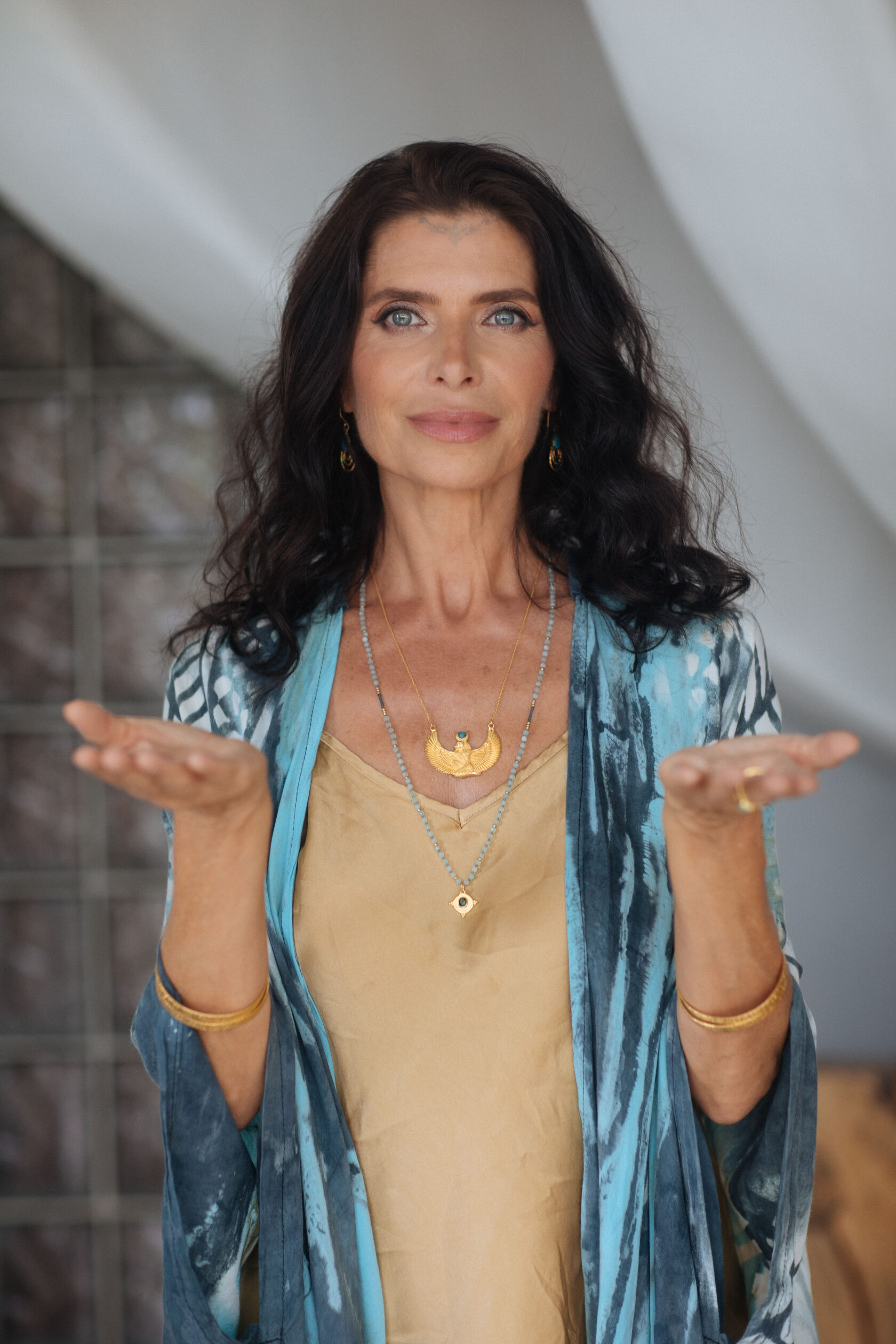
Portrait of Maya Mandala, author of Mandala Dance

Maya Mandala is the author and creator of Mandala Dance, Dakini Dance, Wave Yoga, Egyptian Yoga and Egyptian Dance.

Her root teaching is Dzogchen. Out of years of practice grew a unified system for passing on knowledge about human nature and the original state. Students from many countries have trained in it, and many now lead the practice themselves.

Maya leads international retreats, seminars and master classes at different levels, for men and women, in Europe, Asia and Russia. Her books “Mandala Dance” (2017), “Breath of Life” (2019) and “Mandala Dance. 2nd level” are sold at her certification seminars, and she has recorded a series of video practices and lessons for self-study.

3books by Maya
20+years on the spiritual path
17+years of teaching Mandala Dance
1000+students trained
Authorship

Certificate of deposit

Certificate of Deposit of a Work No. 015-004875 of 10 November 2015, Russian Authors’ Society KOPIRUS: work “Mandala Dance Practice”, author and rights holder Maya Mandala

The work “Mandala Dance Practice” by Maya Mandala is deposited with the Russian Authors’ Society KOPIRUS. The certificate confirms the registration of the work in the society’s registry and the deposit of a copy of it.

Document
Certificate of Deposit of a Work No. 015-004875
Issued
10 November 2015
Work
“Mandala Dance Practice”
ISBN
978-5-4472-5052-2
Author and rights holder
Maya Mandala
Registry
Russian Authors’ Society KOPIRUS, Moscow

The certificate in English. Open it full size · Russian version.

Voices

What practitioners say

“In my personal opinion, everyone should practice Mandala Dance, and I truly believe that it will transform their life the way it transformed mine. Mandala Dance is a way of life. A life of clear presence, self-awareness, and joy.”

Mariana Germanova — certified instructor, Burgas, Bulgaria

“The main lesson I found in myself while dancing Mandala Dance was continuity. It takes time to practice, it takes time for life, for transforming things in our bodies, our minds, our soul and emotions — and this is the journey.”

Aistė Samulienė — certified instructor, Lithuania

“This practice is a treasure of wisdom and intuition, and it also brings benefits related to the body — and, as we know, life is the body. For me, Mandala Dance is a beautiful, light and sacred dance.”

Simona Arslan — Level 1, Vilnius, Lithuania

Read more stories from practitioners

“Keep going, trust yourself, trust life, trust your soul, be yourself, be who you are, bring this life, bring this love — which is deeper than you can see.”
Maya Mandala, in an interview
Questions

Frequently asked questions

What is Mandala Dance?

Mandala Dance is an authorial practice created by Maya Mandala. It is built from smooth spiral, wave and circular movements and figure-eights, coordinated with conscious breathing and attention. The forms follow sacred geometry: the circle, the spiral, the figure-eight and the wave.

Who created Mandala Dance?

Maya Mandala created the practice and has been teaching it for more than seventeen years. She is also the author of Dakini Dance, Wave Yoga, Egyptian Yoga and Egyptian Dance, and of three books.

What does a class look like?

A class builds the dance step by step. It starts with a thorough warm-up of the body and work with attention, then the movement is learned element by element, and as lightness and presence appear in the body the dance goes deeper. The movements — smooth spiral, wave and circular forms and figure-eights — are coordinated with breath and attention.

Do I need dance experience?

The practice starts from the basics and suits beginners. What it asks for is time, patience and a wish to be present in the movement. Maya notes that the first step for any dancer is mastering presence in the body, and that this takes time.

Can I try Mandala Dance before joining a retreat?

Yes. Maya has recorded a Level 1 lesson: a video 85 minutes long with 30 days of access. In it she explains the practice on the physical and energetic levels. It is designed for people who already know Mandala Dance and want to deepen their practice, and it also suits newcomers who want to try the practice on their own. It is a recording for solo practice, without a live instructor. The lesson page has the details and checkout: Mandala Dance Level 1 with Maya.

What are the three levels?

Level 1 is an in-person preparatory retreat where students learn the foundation of the practice, align the body and meet their Individual Mandala; it is not yet the full dance. Level 2 turns the practice toward the circle — empathy, listening and moving in one rhythm with others — and begins the full transition into the dance. Level 3 is the Manifested Mandala of the Universe: wholeness, consciously passing through the states formed by the sacred pattern of the dance.

Why does the practice have levels?

Maya explains it from her own experience. When she first gave the practice whole, it was too strong for many people: it brings up everything a person carries, in body, memory and energy. So she created levels and began to teach more slowly, so that each person can take the practice in on their own level.

Does Level 1 give the right to teach?

The Level 1 retreat is intended for personal practice. A facilitator certificate is issued later in the path, after confirmation of proficiency at the Level 2 or Level 3 stage.

How does one become a facilitator?

The path has four steps: Basics of Life Level 1, Mandala Dance Level 1, Levels 2 and 3 with Maya, and Basics of Life Level 2, where facilitator certificates for Levels 2 and 3 are issued. Facilitators renew their certification regularly: Level 3 after two years, Levels 1 and 2 after one year.

Is it a religious practice?

Mandala Dance is a movement and meditation practice. Maya’s root teaching is Dzogchen and Sufi dance also inspired her path, but she says the practice is “not about tradition” and “not about where you’re coming from”: it follows basic principles of life and of how energy moves. People of different backgrounds and beliefs practise it.

Can men practise?

Maya teaches international retreats and seminars for men and women. In an interview she explains that the practice has two lineages — Mandala for women and Mandala for men: a woman starts from the earth, a man from the sky, and they meet in the heart. So far few men practise, and Maya hopes that one day the full Mandala can be danced together. The Level 1 retreat described on this page takes place in a women’s circle.

Is Mandala Dance a medical treatment?

No. It is a movement and meditation practice, not a medical treatment, and it does not replace professional medical care. If you are pregnant or have a health condition, please talk to your doctor before you join.

What is included in the retreat price?

Accommodation in double or triple rooms and meals are included; flights are paid separately. The hotel has a spa area and a pool in the garden.

What if I need to cancel?

The prepayment is €300. In case of cancellation, €200 is non-refundable and €100 is credited toward participation in Maya’s next event.

Where does the next retreat take place?

In Austria, at the four-star Hotel des Glücks in Sankt Oswald, 9–15 November 2026. The full details are on the retreat page.

How did Maya come to create Mandala Dance?

Maya’s path included years of study in Buddhist and Sufi lineages, tantra workshops and many forms of dance. She was searching for a temple dance for a woman’s body; in meditation her inner voice told her to search through the dance, and over about a year of practice the method took shape. Read the full story.

Where can I practise between retreats?

Maya has released a series of video practices and lessons for self-study; they are collected in the Catalog.

Where can I start?

Choose your first step: read what Mandala Dance is, try the recorded lesson at home, apply for the Level 1 retreat in Austria, or write to us on Telegram (t.me/Mayamandala) or by email (maya-mandala@yandex.ru). We will help you choose the right format.

Dance your way back to yourself

Try a recorded lesson at home, join the Level 1 retreat in Austria, or write to us with any question — we will help you take the first step.

Or email maya-mandala@yandex.ru.

Sources: an interview with Maya Mandala (video); her conversation with Valentina Fratu; the 2014 Mandala Dance seminar; materials of mayamandala.com.

Published · Last updated .

© Maya Mandala, 2026. All rights reserved. The work “Mandala Dance Practice” is deposited with the Russian Authors’ Society KOPIRUS: certificate of deposit No. 015-004875 of 10 November 2015.

Next retreat: Mandala Dance Level 1 with Maya · 9–15 November 2026 · AustriaJoin the retreatTry at home
Made on
Tilda