


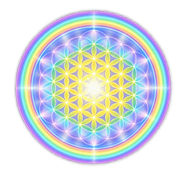
Sacred Geometry
The study of geometric patterns and proportions found throughout nature. The individual patterns are ancient and cross-cultural; the field's name and framework are a 20th-century addition.
- Term
- Sacred Geometry
- Category
- Cross-Tradition Concept
- Related Concepts
- Mandala, Flower of Life, Meditation, Archetypes
- Level
- Intermediate
What Sacred Geometry Means
Sacred geometry is the study of geometric patterns, ratios, and proportions — the spiral of a seashell, the branching of a tree, the symmetry of a snowflake — treated as meaningful rather than incidental. Temples, cathedrals, and meditation spaces across cultures have been built using specific geometric proportions, and forms like the mandala are used directly as objects of contemplation.
Origins: Old Patterns, a New Name
The individual patterns studied under "sacred geometry" are genuinely ancient and appear independently across cultures — in Egyptian, Greek, Mayan, and many other architectural and artistic traditions. But the term "sacred geometry" itself, as a named field bringing these patterns together under one framework, was popularized in the twentieth century, significantly through the work of artist and theorist Jay Hambridge, who studied proportion and symmetry in Greek art and architecture in the early 1900s. What feels like one continuous ancient discipline is, more precisely, an old set of patterns organized under a comparatively recent umbrella term.
The Golden Ratio: What Holds Up and What Doesn't
The golden ratio (approximately 1.618) is one of the most frequently cited patterns in this field, and part of its reputation is well earned: it genuinely describes the spiral arrangement of seeds in a sunflower head and scales in a pinecone, connected to the mathematics of Fibonacci-related plant growth. Other popular claims are considerably weaker. The idea that the golden ratio governs "ideal" human body or facial proportions has been examined directly by researchers, including a 2024 review in a maxillofacial surgery journal, and found to have no convincing supporting evidence — the claimed measurements tend to rely on cherry-picked reference points rather than a consistent, verifiable ratio. Historical claims linking the golden ratio to Leonardo da Vinci's Vitruvian Man or to the proportions of the Parthenon are similarly popular but not well documented.
Contemporary and Popular Interpretations
In much contemporary spiritual writing, sacred geometry is often presented as a "hidden language of the universe" or direct evidence of cosmic design. This is a meaningful lens for many practitioners, but it goes well beyond what the historical and mathematical record actually supports. The more grounded version of this field is narrower and, in some ways, more interesting: certain proportions really do recur in nature for identifiable mathematical reasons, and contemplating pattern and symmetry has a long, genuine history as a meditative practice across cultures — without needing every claimed pattern to be equally well established.
How Maya Mandala Uses This Concept
In Maya Mandala's system, the mandala — a circular geometric design — is a central tool for inner work: not only looked at, but danced, walked, and moved through. Geometric forms are used as a focus for attention, a way of training the eye and mind to notice pattern and order.
- it is a way of seeing — training attention to notice pattern amid apparent chaos;
- it is a meditation tool — resting on a geometric form can quiet mental chatter;
- it is embodied — the mandala is danced and moved through, not only viewed;
- it is cross-cultural — related geometric principles appear in traditions worldwide, even where the modern label does not.
Common Misconceptions
The golden ratio precisely governs shapes like shells, faces, and bodies
Some cases are genuine — the spiral growth patterns in certain shells and plants are mathematically well documented. Claims about the human body and face are not: a 2024 review of the evidence found no convincing support for the golden ratio as a rule of human proportion.
"Sacred geometry" has been a single, continuous named tradition since ancient times
The individual patterns are ancient and cross-cultural. The unifying term and framework are a twentieth-century addition, significantly shaped by early-1900s work on proportion in art and architecture.
Sacred geometry is itself a religion or belief system
It is better understood as a practice of observing and contemplating pattern. It appears within many religious and spiritual traditions but is not, on its own, a religion.
Related Concepts
In Maya Mandala's Self-Discovery Dictionary, this concept connects to other terms:
Related Articles
Read more on the Maya Mandala blog:
Frequently Asked Questions
What is sacred geometry in simple terms?
It is the study of geometric shapes and proportions that recur in nature, used across cultures as a focus for meditation and contemplation.
Is sacred geometry a religion?
No. It is a way of observing and contemplating pattern. It appears in many religious and spiritual traditions but is not a religion itself.
Is the term "sacred geometry" itself ancient?
No. The individual patterns are ancient and cross-cultural, but the term and unifying framework were popularized in the twentieth century, notably through Jay Hambridge's work on proportion in Greek art and architecture.
Does the golden ratio really appear in the human body?
The evidence does not support this. A 2024 review of the research found no convincing support for the golden ratio as a rule of human body or facial proportion, though it does genuinely describe some plant growth patterns.
How does Maya Mandala use sacred geometry?
The mandala is a central tool in Maya's practice — not only a visual symbol but a form to be danced and moved through.
The Takeaway
Sacred geometry rests on a real observation — certain proportions do recur in nature for identifiable reasons — organized fairly recently under a modern name. Some popular claims built on top of that observation, especially about the golden ratio and the human body, don't hold up to scrutiny. In Maya Mandala's practice, geometric form is used directly and physically, through the mandala, as a focus for attention and movement.
Where do you see repeating patterns in your own life — and what order might they reveal?
No need to answer. Just notice what arises.
Programs for Deep Inner Work
Practices that help you approach this topic with awareness.

Unfolding Your Abilities
Developing awareness, intuition, and the ability to see the whole picture.
Learn More
Mandala Dance. Level 1
A retreat exploring embodied movement, presence, and creative expression through Maya's signature Mandala Dance method.
Learn More